
Nordic Hybrid work model: Why Northern Europe Doesn’t Look Back
Why the Nordic–Baltic Region Stopped Arguing and Started Designing Work
Between 2019 and early 2026, the global debate about work split into two very different conversations. One of them led to the Nordic hybrid work model, now seen as Europe’s most durable redesign of work.
In the United States, leaders are still asking “Should people come back to the office?”.
In Northern and Eastern Europe, that question has already been answered and replaced by action.
While much of the world oscillated between lockdowns, mandates, and reversals, the Nordic hybrid work model became the standard in Northern Europe. Because trust beats presence, design beats control, and flexibility beats symbolism.
The result is a durable hybrid operating system embedded into labour law, digital infrastructure, and talent strategy.
This article explains:
- Why Europe institutionalized hybrid work while the US re-politicized it
- Why headline “remote work percentages” often lie (Latvia is the best example)
- Why the Nordic–Baltic model produces less noise and more execution
- And what senior leaders should take away if they’re building organizations meant to last
When trust is the baseline, hybrid work is not a perk but an operating system.
The Pre-Pandemic Baseline: Remote Work as an Exception (2019)
In 2019, remote work was peripheral to labour-market design—an accommodation, not a strategy.
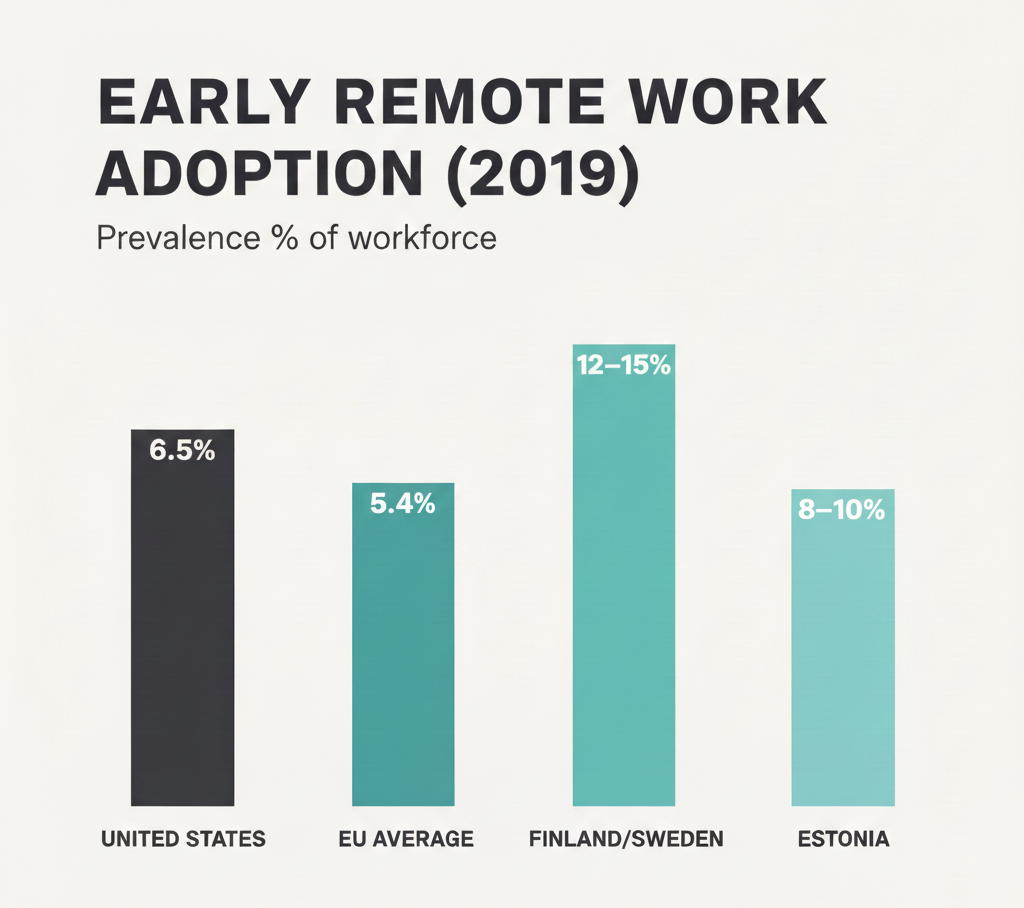
- U.S.: 6.5% of private-sector workers primarily worked from home.
- EU: 5.4% of employees teleworked regularly.
These numbers reflected a belief that supervision, productivity, and collaboration required presence.
The Nordics and Baltics diverged early:
- Finland & Sweden: ~12–15% remote work
- Estonia: ~8–10%, enabled by digital ID systems and e-government services
These figures reflected institutional readiness: high trust, digital public services, and outcome-based management rather than ideological enthusiasm.
Table 1. Remote Work Prevalence Before the Pandemic (2019)
| Region / Country | Remote Work Prevalence | Primary Driver | Dominant Stance |
| United States | 6.5% | Operational efficiency | Office-centric |
| European Union (avg.) | ~5.4% | Work–life balance | Conservative |
| Finland / Sweden | ~12–15% | Digital integration | Trust-based |
| Baltics (Estonia focus) | ~8–10% | E-governance, startups | Tech-forward |
Pandemic Shock, Forced Proof-of-Concept, Then Optimization (2020–2022)
The COVID-19 pandemic functioned as a global stress test:
- 48% of EU employees worked remotely
- 60% of U.S. paid workdays were remote
Emergency continuity quickly evolved into a large-scale experiment in distributed work.
The Nordic and Baltic regions transitioned with comparatively little friction. Existing digital infrastructure, widespread laptop penetration, and digitally enabled public services reduced operational shock.
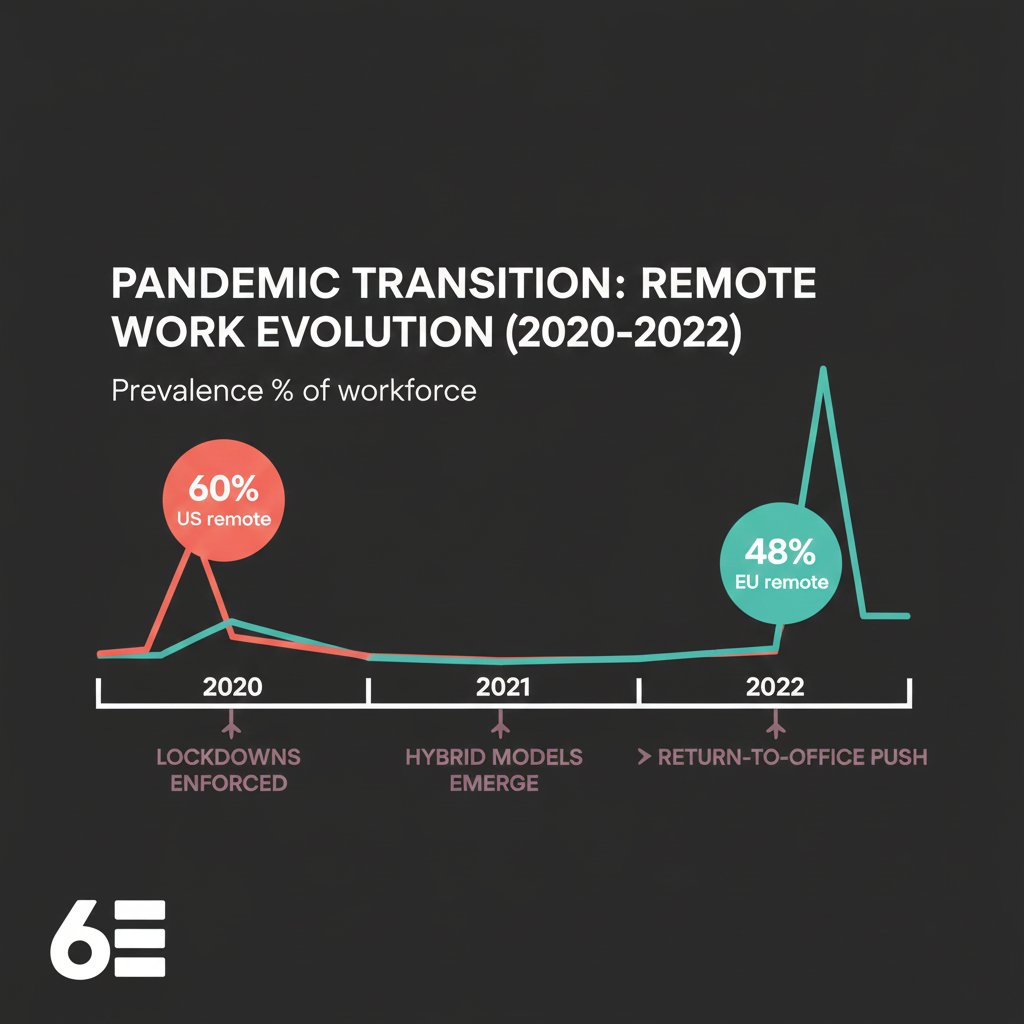
By 2021, remote participation in knowledge roles surged by 30+ percentage points. The question shifted from “Can this work?” to “What does sustainable design look like?”
Employees quickly embraced it: ~80% preferred remote or hybrid arrangements by late 2022.
From Experiment to Policy: Transatlantic Divergence (2023–2026)
The United States: Mandates, Stabilization, and Friction
From 2023 onward, many large U.S. employers reinstated office-attendance requirements. By late 2024, approximately 75% of U.S. workers were subject to regular in-office mandates.
Vacancy analytics show how this translated into hiring practices by Q3 2025:
- 64% fully on-site postings
- 24% hybrid postings
- 12% fully remote postings
This marked a clear contraction from the early-2022 remote peak. The shift occurred despite persistent employee demand for flexibility, producing visible supply–demand tension.
The rationale often wasn’t performance but commercial real estate. RTO mandates increasingly functioned as balance-sheet stabilisation mechanisms rather than responses to demonstrated productivity failures.
Europe: The Institutionalization of Hybrid Work
Europe followed a structurally different path. Rather than mandating presence, governments and employers focused on codifying flexibility through labour standards and collective agreements.
By 2023, nearly half of European organisations had introduced permanent remote or hybrid policies, with another quarter planning to do so by 2025.
Germany stabilized into a structured hybrid mode, validating the broader European trajectory. UK data reveals tension: hybrid is widespread, fully remote is rare, yet demand remains high.
By early 2025,
- 34% of EMEA job postings were hybrid
- Hybrid became the default for professional and knowledge roles not a perk
How the Nordic Hybrid Model Redefined Remote Work in Europe
The Nordic–Baltic corridor leads by embedding hybrid as a system.
Nordregio research confirms the trend: hybrid, not fully remote, is the dominant model.
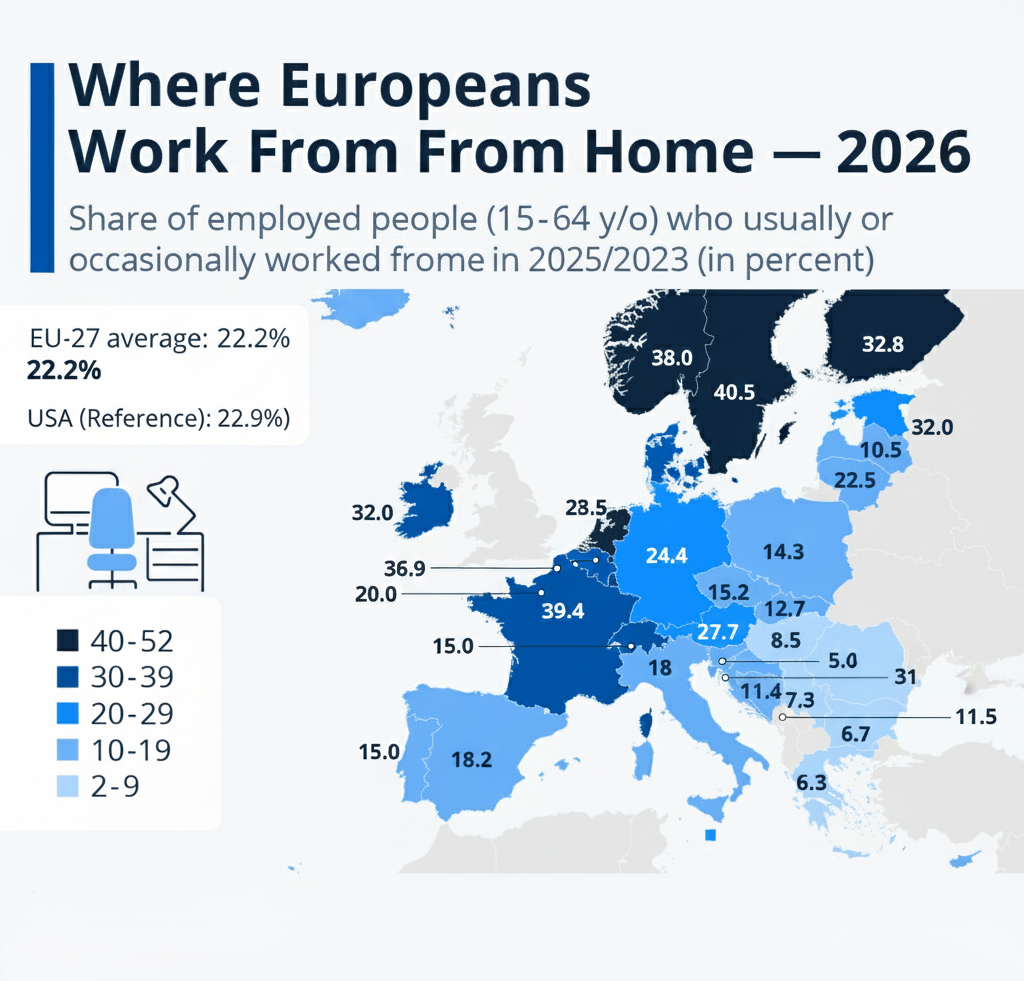
- In Finland, Sweden, Norway, and Denmark, more than 40% of employees worked remotely at least part-time—nearly double the EU average of 22.2%.
- Finland reported that 35% of wage earners continued to work remotely in 2023.
- Estonia maintained high hybrid adoption across its tech and public sectors.
Offices in this region increasingly function as coordination and collaboration hubs. Execution happens anywhere.
Three core principles define the Nordic model:
- Trust over control (outcomes > presence)
- Public digital infrastructure as a foundation
- Purposeful office design (not mandated desks)
While the Nordic–Baltic region has largely stabilised into a post-pandemic hybrid equilibrium, France continued to expand flexible work into 2025 and 2026. By early 2026, around 39% of French employees worked from home at least occasionally, overtaking parts of the Nordic cluster on overall hybrid participation. This acceleration was driven less by culture and more by legal institutionalisation: formal rights to request telework, the “right to disconnect,” and a rapid rise to 3,400+ coworking spaces nationwide. France shows how hybrid work can scale quickly when flexibility is written into labour law—contrasting with the Nordics, where early adoption was trust-based and has now reached a stable plateau.
Latvia Explained: Why Headline Remote Percentages Mislead
Latvia’s 10.2% remote/hybrid figure (Q3 2025) appears low but it’s misleading. It includes the entire labour force, including sectors like manufacturing, retail, transport, and logistics.These sectors together account for approximately 89.8% of on-site work in Latvia.
What Sectoral Data Really Says About the Hybrid Work Divide
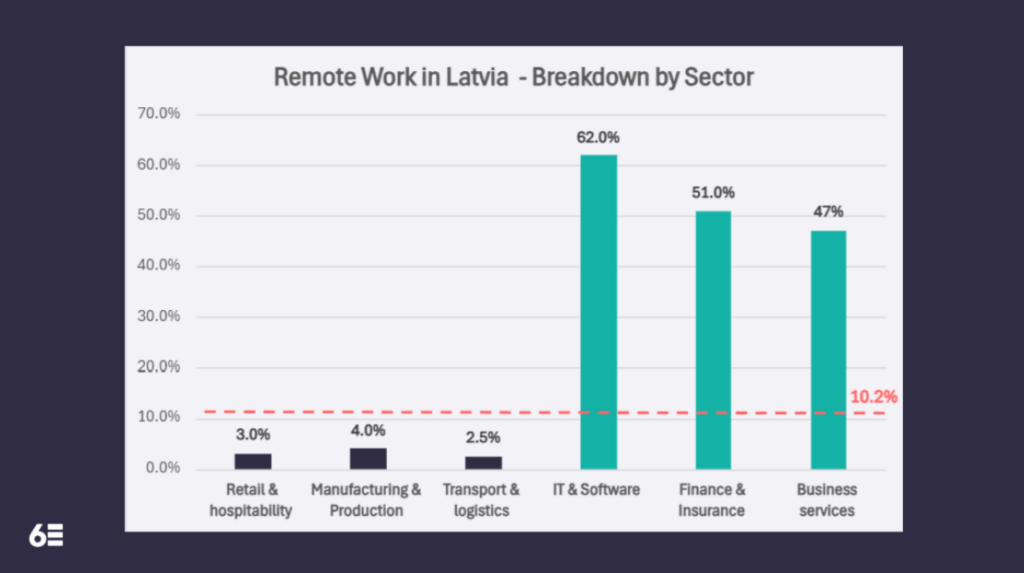
| Indicator | Value | Context |
| National remote / hybrid share | 10.2% | Entire labour force |
| IT & finance remote share | ~50% | Knowledge-worker reality |
| On-site majority | ~89.8% | Retail, manufacturing, logistics |
| Pandemic peak (2021) | 18.9% | Emergency lockdown phase |
Latvia’s economy has a higher proportion of physically bound roles than Nordic peers, which mechanically suppresses national averages. Using a single headline percentage to compare Latvia with Finland or Sweden creates a false equivalence.
In practice, Latvia’s knowledge economy mirrors Nordic flexibility. Its national figure reflects labour composition, not resistance. In IT, finance, shared services, and business support functions, remote or hybrid work is the default. The decline from the 18.9% pandemic peak therefore reflects normalisation, not regression.
This distinction is critical:
- National figures answer: How many jobs can be done remotely at all?
- Sectoral figures answer: How competitive employers actually organise work today.
Ignoring occupational structure is a category error, not a data critique.
This aligns with our earlier findings on why Baltic leadership roles remain structurally hard to fill flexibility is part of the competitive edge.
Vacancy Analytics and the “Remote Work Gap”
Across platforms, remote and hybrid roles attract 2–3x more applicants than on-site roles. Europe addresses this through hybrid normalisation. The U.S. continues to experience misalignment, friction, and talent loss.
As of early 2026, remote and hybrid roles represent roughly 20% of job postings yet attract around 60% of applications. This “remote work gap” is most acute in the United States but remains visible across Europe, particularly in the Nordics and the UK.
Recruiter fatigue and applicant misalignment, what we previously called the ‘AI hiring bubble’, are deepened by poor flexibility offerings.
The Nordic–Baltic Digital Backbone (2025–2030)
The resilience of the Nordic–Baltic model rests on institutional alignment rather than ad-hoc employer policy. The Nordic-Baltic Roadmap for Digitalisation 2025–2030 frames the region as a single, digitally integrated labour market.
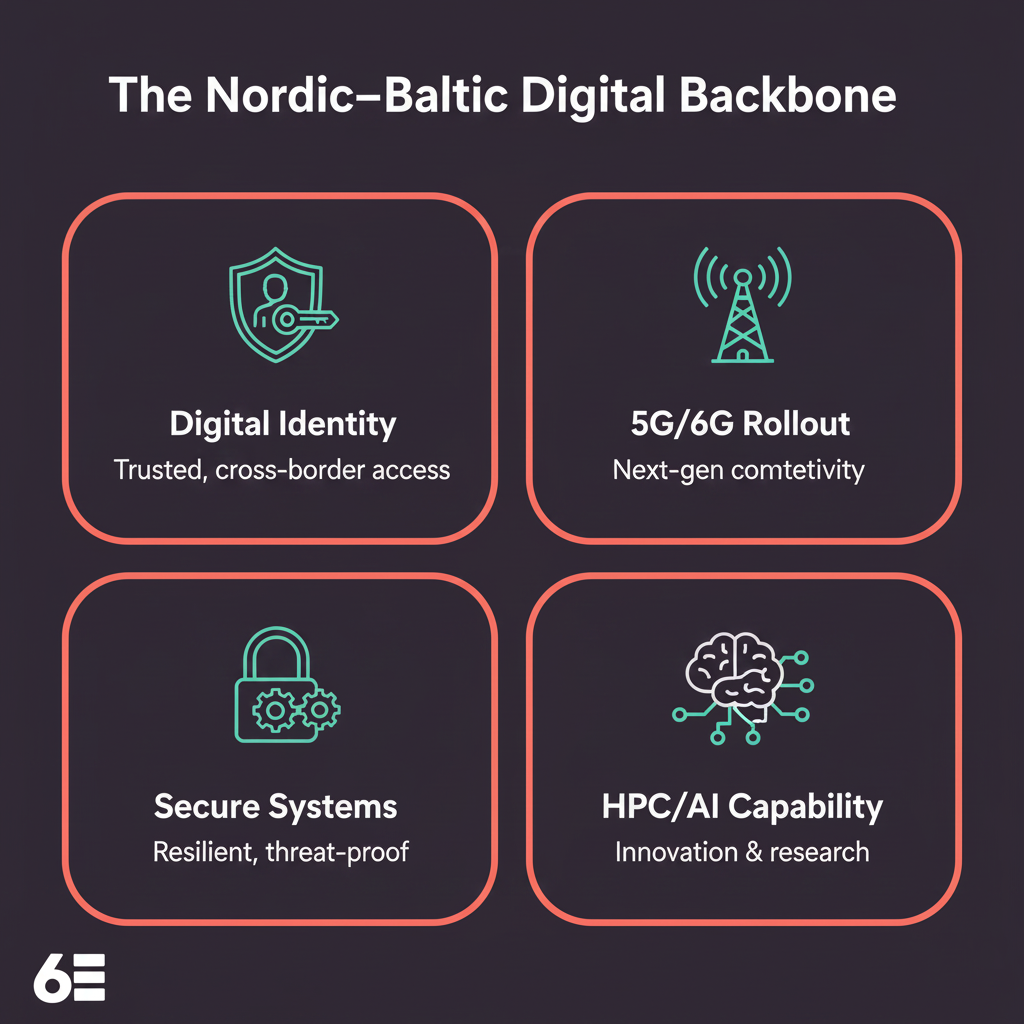
Core pillars include:
- Interoperable digital identities enabling cross-border work without relocation
- 5G and emerging 6G infrastructure extending connectivity beyond cities
- Secure and resilient digital systems
- High-performance computing, anchoring advanced R&D and AI development
Remote and hybrid work are explicitly treated as green enablers, reducing commuting-related emissions by up to 54% and supporting climate goals.
Remote Staffing as a Geostrategic Innovation Lever
The Nordic–Baltic corridor now treats Central and Eastern Europe as an innovation reservoir and a capability hub:
- Poland: Over 744,000 ICT professionals; ~80,000 STEM graduates annually
- Romania: ~196,200 ICT specialists; growing AI clusters
- Czech Republic: 217,000+ ICT professionals; cybersecurity hubs
- Baltics: Elite clusters in AI, cybersecurity, and software R&D
Nordic and Western European firms increasingly build integrated product and R&D teams across Helsinki, Tallinn, Warsaw, and Bucharest, aligned by time zone, regulation, and digital infrastructure.
With senior roles remaining vacant for weeks, as discussed in our analysis of the hidden costs of open positions, flexible work models aren’t just talent perks, they’re strategic necessities.
Economic Logic: The Salary–Flexibility Trade-Off
Flexibility reallocates value between wages, retention, and productivity rather than destroying it.
- 60% of remote or hybrid workers are willing to accept lower pay to preserve flexibility
- OECD data shows employees save €2,300–€3,700 annually. In Nordic capitals, that jumps to €6,000–€12,000, factoring in transport, meals, and time.
- Employers save ~$10,000 per employee per year in real-estate expenses (OECD and McKinsey studies) and see materially lower attrition.
Bottom line: hybrid persists not because it’s fashionable, but because economics lock it in.
Conclusion: The Nordic–Baltic Blueprint, Revisited
The United States continues to oscillate between mandates and market pushback.
By early 2026, the debate over “return to office” had largely bypassed the Nordic–Baltic region. The question there is no longer where work happens, but how it is designed.
Nordic–Baltic countries lead in building sustainable, trusted hybrid models with less friction, better employee alignment, and legally embedded flexibility.
In the emerging global knowledge economy, the most competitive organisations are not those that enforce presence, but those that design work to function without borders.
References and Data Sources
- Eurostat – Telework prevalence across EU-27 (2019–2025)
- Eurofound – COVID-era work-from-home trends and hybrid adoption
- U.S. Bureau of Labor Statistics (ATUS) – Remote work in U.S. private sector (2019)
- WFH Research (Barrero, Bloom, Davis) – Global Survey of Working Arrangements
- LinkedIn Economic Graph & Indeed Hiring Lab – Vacancy analytics and the remote work gap
- Robert Half – U.S. job posting breakdown (Q3 2025)
- Statistics Finland & Latvian Central Statistical Bureau – Regional hybrid work rates
- Nordic Council of Ministers – Digitalisation Roadmap (2025–2030)
- European Commission – Telework, labour rights, and digital work policy
- PwC, McKinsey, Gartner, BCG – Talent strategy, hybrid work economics, AI, and productivity trends
- Gallup – Flexibility vs salary trade-offs and retention dynamics
- European Environment Agency – Remote work impact on emissions